Equa Blog - News, Views and Ethical Styling...
Showing posts with label Hemp. Show all posts

Thursday, 8 July 2010

Eco Fabrics

Have you ever wondered what an ‘eco-fabric’ actually is?

There are many variables to consider when classifying a fabric as being an ‘eco-fabric’. This includes everything from how the raw material is grown, the manufacturing process, the chemicals used to dye the fabric to the fabric ultimately being biodegradable or recyclable.

Over the next few weeks Equa will be featuring a different eco-fabric of the week…..

HEMP


Eco Credentials:
Hemp has been associated with cannabis since the 70’s but it is much more than that. For over a thousand years hemp was in fact the world’s largest agricultural crop, it was even the primary source of protein for both humans and animals. Hemp is now used commercially in a wide variety of products, such as paper, biodegradable plastics, health food, and textiles.

A hemp crop will yield 4 times as much raw fibre as an equivalent sized tree plantation. Hemp is a very hardy plant which can be grown in almost any climate and soil condition, allowing it to be grown on otherwise unusable land. It requires no pesticides or herbicides to grow, even replenishing the soil with nutrients such as nitrogen.

Characteristics:
Traditionally hemp produced a coarse woven fabric not suitable for clothing; however recent developments in processing have made it possible to soften the coarse hemp fibres into a soft wearable fabric.

If woven tightly hemp fabric acts as a natural sun screen by repelling 95% of UV rays. It is also a very light and airy fabric while being very strong and durable.


This summer try Equa’s Komodo Cobalt Tunic it is a hemp/cotton mix and has a raw  loosely woven quality, which gives it a natural feel...


                                                                                                  In contrast the Stewart Brown Varley Pleat Dress is made from more tightly woven hemp giving it a fine drape and luxurious finish.

Monday, 1 December 2008

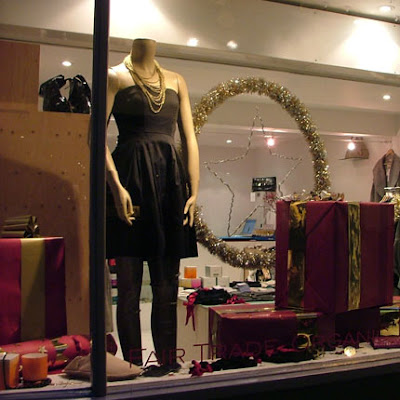
Equa's Christmas Windows

The festive season is upon us and at Equa we have put two of our favourite party outfits in the window to celebrate.

Pictured above is Annie Greenabelle's organic cotton Prom Dress in black accessorised with a Chain Necklace by Pippa Small for Made and Silver Leggings by Noir. It's all about the sparkle!


Keeping the metallic theme here we have the Bronze Hobo Dress in a hemp silk mix by Julia Smith teamed with organic cotton jersey Ski Pants by Annie Greenabelle. Also just seen is a the Brass Link Bracelet by Made.

Thursday, 23 October 2008

Your Wardrobe's Water Footprint

We hear a lot about our carbon footprint and the need to reduce it, but do you ever think about your water footprint?

On the Water Footprint Network (WFN) website you can calculate your individual water footprint. The links between domestic water use and the size of your footprint are fairly obvious but I found the section on virtual water use particularly thought provoking. The virtual water content of a product refers to the sum of all the fresh water required to produce it. Along its various stages of production one cotton shirt for example requires approximately 2,700 litres of water to produce (See the WFN product gallery for more details). The effects of this consumption are felt most keenly in the areas where the cotton is grown, often in semi arid conditions in developing countries. The consequences of intensive irrigation can be disastrous. In Uzbekistan drawing water for irrigation from rivers that feed the Aral Sea caused it to loose 60% of its area and 80% of its volume between 1960 and 2000 (See The water footprint of cotton consumption).

This highlights to me the importance of choosing less 'thirsty' materials such as hemp and utilising recycled fabrics. Or in the case of cotton going for organic cotton. Organic cotton is preferable to conventionally grown cotton for several reasons. Fertilizers, pesticides, and insecticides all require water to dilute them. Moreover the crop rotation system used in organic farming allows the soil to have better water retention due to increased organic matter in the soil. In addition precious water supplies are less likely to become contaminated from run-off of agricultural chemicals used in the cotton fields.


From left to right: Recycled Parachute Dress by Debbie Little, Hemp/Silk Hobo Dress by Julia Smith, Organic Cotton Rennie Jeans by Ruby.

Thursday, 16 October 2008

Equa In Grazia

The fabulous bronze Hobo Dress by London designer Julia Smith, now avaliable at Equa, features in this week's Grazia magazine.